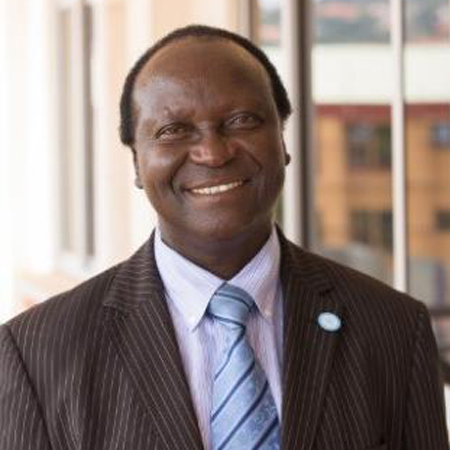
Chebet Maikut

Chebet Maikut is Vice-President of the Eastern Africa Farmers Federation (EAFF), an association that brings together the members of national farmers’ organisations from Kenya, Tanzania, Uganda, Rwanda, the Democratic Republic of Congo, and Burundi.

Mr. Maikut is also the President of the Uganda National Farmers Federation. Prior to that, he served as a member of parliament representing the Kween Constituency in Uganda’s National Assembly, in which he led several standing and sessional committees. He also served as a Constituent Assembly Delegate, an elected body that debated, passed and promulgated Uganda’s 1995 constitution. Earlier, Mr. Maikut worked for 16 years in Uganda’s public sector, in the then Ministry of Natural Resources, from which he resigned in 1996 after attaining a senior position. Mr. Maikut also served as a local district councillor in his home district of Kapchorwa.

Educated at Makerere University, Uganda, and Lincoln University, New Zealand, Mr. Maikut holds degrees in forestry and natural resources management.

Mr. Maikut, with his rich experience in both the public and private sectors, as well as in the non-profit sector, has served in several committees, boards, task forces, and international organisations in a variety of capacities over the years. He is currently a member of the Board of Directors of the National Agricultural Advisory Services, of the National Council for Higher Education, of the Uganda AIDS Commission Partnership Committee, and of Uganda’s National Biosafety Committee. At the international level, Mr. Maikut sits on DuPont’s Biotechnoloy Advisory Panel and is a member of the New Partnership for Africa’s Development (NEPAD) think tank.

Mr. Maikut’s main interest areas include advocacy work, poverty reduction and rural development, natural resources and environmental issues, HIV/AIDS, education, human rights and democracy.

EAFF’s role is to voice legitimate concerns and interests of the farmers of the region at regional and international levels with the aim of enhancing regional cohesiveness and the socio-economic status of the farmers. Its mission is t o facilitate representation and capacity-building of farmers in the region on issues related to sustainable utilization of natural resources in an equitable and just manner, so as to contribute to the realization of regional food security, industrialization, favorable markets and incomes.